From inspiration to booked trip.
Compare trip inspiration with booking organisation. See where Venture fits once you’ve decided where to go.
Use both. Prompt an AI for the shape of the trip, then let Venture hold the bookings, the money and the documents.
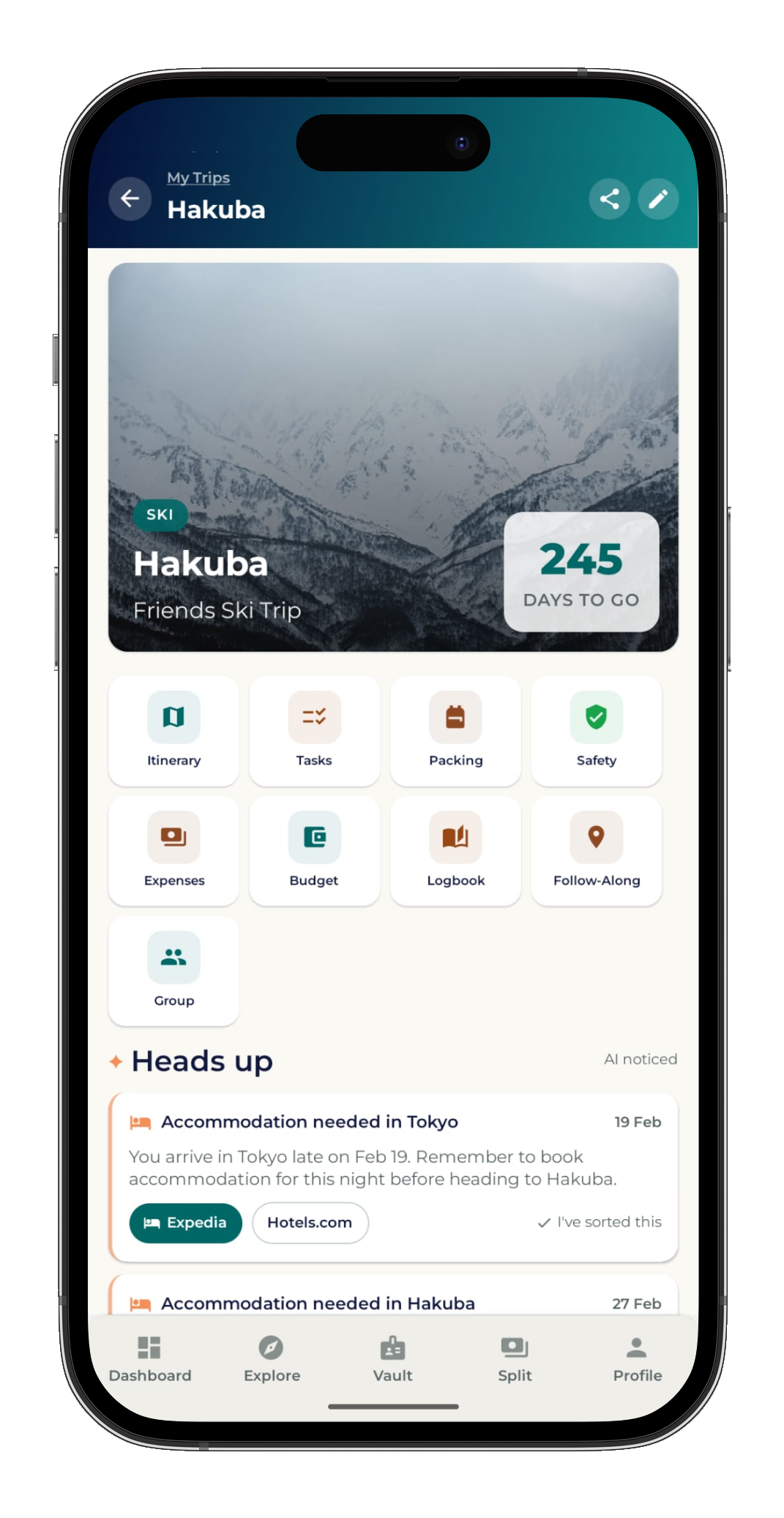
Two different jobs, one after the other.
| Job | AI trip planners | Venture |
|---|---|---|
| Suggest where to go and what to do | Yes, this is what they are for | No, Venture does not invent plans |
| Draft a day-by-day from a prompt | Yes, in seconds | No |
| Hold your real bookings | No, the plan is a suggestion | Flight numbers, times, references, costs |
| Where the details come from | Generated, so worth checking | Read from your own confirmation |
| One shared plan for the whole group | Usually a chat you have to copy out | Everyone sees the same trip |
| Split what the trip costs | No | Pre-trip & on-trip, in the same plan |
| Document vault (passports, certs, insurance) | No | Per person, offline |
| Activity packing templates (dive, ski, overland) | A generated list, not a checkable one | Yes, tick off offline |
| Works at the gate with no signal | No, needs a connection | Fully offline |
What AI planners are genuinely good at
The hardest part of planning a trip is often the first hour, when nobody has decided anything. An AI planner is very good at that hour. Describe a rough idea, a budget and some dates, and you get a plausible shape for the trip back in seconds: a route that makes geographic sense, how many nights each stop is worth, the things most people would want to do. For breaking a deadlock in a group chat, it is a genuinely useful tool, and it beats an afternoon of open browser tabs.
It is also fast at the narrow questions. Is four nights too long in one place. What is the sensible order for these five cities. What do people usually do here when it rains. These are questions with reasonable-consensus answers, which is exactly the kind of question a language model handles well.
Where the handover breaks
Then you book something, and the AI plan quietly stops being the plan.
The itinerary it produced is a suggestion. It does not contain your flight number, your booking reference, the actual check-in time on the hotel confirmation, or what any of it cost. The moment your real trip differs from the suggestion, which is immediately, because the flight you could actually get leaves at 06:25 and not at the civilised hour in the draft, the generated plan becomes a document you have to maintain by hand. Most people paste it into a note or a spreadsheet and it goes stale within a week.
There is a second problem specific to generated plans: you cannot fully trust the details. Opening hours, prices, whether a particular boat still runs in March. Any of it may be confidently wrong, because a model is predicting a plausible answer rather than reading a source. That is fine when you are still deciding. It is not fine when it is the thing you are navigating by at 6am in an unfamiliar airport.
And none of it is shared in any real sense. The plan lives in one person's chat history. Getting it to the rest of the group means copying it somewhere else, which is where the six-tool sprawl starts again.
What Venture does instead
Venture does not try to invent your trip. It uses AI for a much narrower and more checkable job: reading the bookings you already have.
Forward a confirmation email to your trip, or import a photo, screenshot or PDF of one, and Venture pulls out the flight number, the times, the reference and the cost, and puts them on a shared timeline. Every detail traces back to a document you were sent by the airline or the hotel, so there is nothing to fact-check. You can add anything by hand and edit anything that was imported.
From there it holds the parts a generated itinerary never touches. What the trip is costing and who fronted it, split across the group. Each traveller's passport, certification card and insurance in a per-person vault. A packing list that matches a dive trip, a ski week or an overland route, that you can tick off with no signal. And the whole plan readable offline, which is the state you are actually in when you need it most.
"Bringing it all together, once you book something, saving all the info together." (Venture survey respondent)
The honest answer: use both
These are not competing products so much as consecutive ones. Prompt an AI planner for the shape of the trip, argue about it with your friends, then go and book the flights. From the confirmation email onward, that is Venture's half of the job.
If you want a rule of thumb: an AI planner is for the trip you are considering. Venture is for the trip you have paid for.
Which should you pick?
If you have not decided anything yet and you want ideas fast, start with an AI planner. If you have bookings piling up in your inbox, people who owe each other money, and a group that keeps asking you to resend the details, that is the problem Venture was built for, and no amount of prompting solves it.
Keep the ideas. Hold the real trip.
Forward a booking and watch the itinerary build itself. Costs, documents and your whole group in one place, offline-ready. Free.
Get the appComparing something else? See Venture vs Wanderlog, Venture vs TripIt, Venture vs Splitwise and Venture vs a spreadsheet. Or read how the itinerary builds itself from a forwarded email.
Venture vs AI trip planners, answered.
Does Venture generate itineraries with AI?
No. Venture uses AI to read the bookings you already have, not to invent ones you don't. Forward a confirmation email, or import a photo or PDF of one, and Venture extracts the flight number, times, reference and cost and puts them on your timeline. Every detail traces back to a real confirmation, so there is nothing to fact-check.
Can I use ChatGPT and Venture together?
That is the combination we would recommend. Use an AI planner for the blank-page part: where to go, roughly how long, what is worth doing. Then once you book something real, forward the confirmation to Venture and let it hold the actual trip, the costs and the documents from there.
Is Venture an alternative to Layla or Mindtrip?
It solves the next problem rather than the same one. Layla and Mindtrip are strong at suggesting a trip. Venture is built for after you commit: real bookings on a shared timeline, costs split across the group, documents in a per-person vault, and the whole plan readable offline.
Why can't an AI planner just hold my bookings too?
Some are starting to try. The hard part is not the chat, it is everything around it: parsing a confirmation reliably, keeping one shared plan in sync across a group, tracking who paid what, and still working at the gate with no signal. Those are the parts Venture was built around.
Keep the ideas. Add the real trip.
Venture is free on iPhone and Android. No subscription, no credit card.